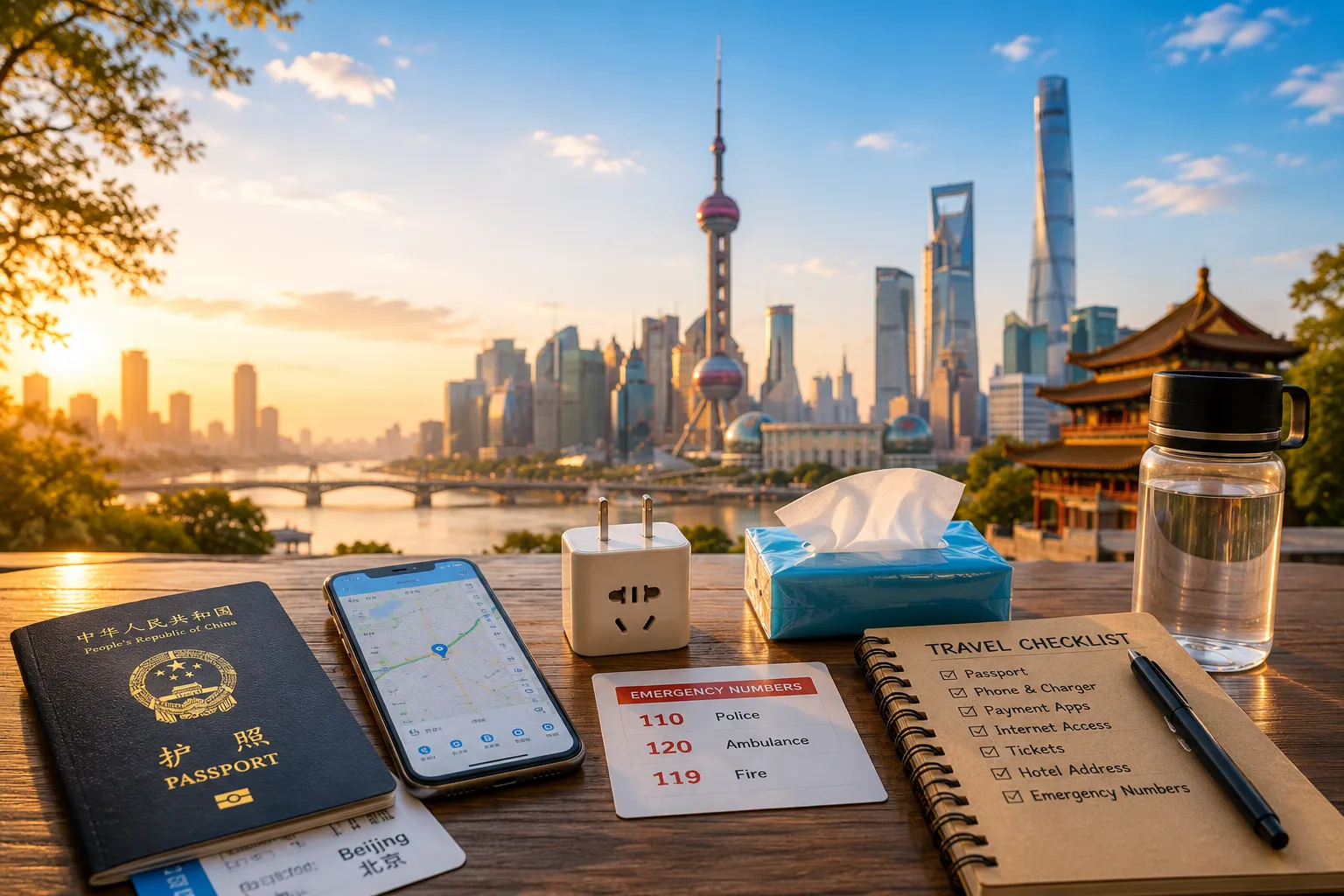
Must-Know Basics for China
Practical essentials for a smoother first trip.
Last verified: October 2026
Report outdated informationBefore you go
Set up the essentials before departure so daily travel feels easier from the moment you arrive.
Set up mobile payment
Prepare Alipay or WeChat Pay before relying on them during your trip.
- Mobile payment is widely used in shops, restaurants, taxis, and attractions.
- Link and test an eligible bank card before departure when possible.
- Keep some cash or a physical card as a backup for unexpected situations.
Prepare internet access
Arrange roaming, an eSIM, or a local SIM before you need maps or payments.
- Choose your roaming, eSIM, or local SIM plan before arrival.
- Confirm that SMS verification will still work while you are in China.
- Download essential information for offline use in case your connection is interrupted.
Save documents and Chinese addresses
Keep the details needed for bookings, check-in, and getting around easy to reach.
- Carry your original passport and use its exact name for transport and attraction bookings.
- Store secure digital copies of your passport and important confirmations.
- Save your hotel address plus key station and attraction names in Chinese.
Bring the right power adapter
China uses 220V power, so check both voltage and plug compatibility.
- Most phone and laptop chargers support 100–240V, but check the label.
- You may still need a plug adapter depending on your device plug type.
- A compact multi-port travel adapter is useful when hotel sockets are limited.
Install and test essential apps
Prepare the tools you will use for maps, translation, rides, and bookings.
- Prioritize map, translation, ride-hailing, and booking apps.
- Sign in and complete any required identity checks before departure.
- Learn where each app stores tickets, bookings, and QR codes.
Daily life
Small everyday habits that make travel smoother once you are in China.
Use bottled, boiled, or filtered water
Do not assume tap water is suitable for drinking directly.
- Hotels usually provide bottled water or an electric kettle.
- Buy bottled water from convenience stores or supermarkets for travel days.
- If you have a sensitive stomach, be cautious with ice or drinks from very small shops.
Carry tissues and hand sanitizer
Some public toilets may not provide toilet paper, tissues, or hand soap.
- Carry a small tissue pack when you go out.
- Hand sanitizer or wet wipes are useful for long travel days.
- Shopping malls, hotels, and larger venues usually have better facilities.
Warm water is common
Restaurants, hotels, and trains may offer warm or hot water more often than cold water.
- Warm water is often considered normal and polite to offer.
- Cold water may not be served automatically.
- You can ask for bottled water, cold drinks, or ice, but availability varies.
Expect a faster pace in busy places
Major stations, metro systems, shopping streets, and attractions can feel crowded.
- Prepare tickets, QR codes, and passports before reaching checkpoints.
- Crowds can be much larger during public holidays.
- Allow extra time for security checks, queues, and station transfers.
Shopping is highly digital
Payment, receipts, refunds, and tax-free services may work differently from abroad.
- Mobile payment is widely used in malls, supermarkets, and convenience stores.
- Keep receipts if you may need a return, refund, or tax-free service.
- Large malls are usually easier for first-time visitors than small local markets.
Food & dining
A few dining habits can make restaurants and shared meals easier to navigate.
Ask for a fork or spoon if needed
Chopsticks are standard, but many restaurants can provide other utensils.
- Hotels, large restaurants, and tourist-friendly places are more likely to have forks.
- Small local restaurants may only offer chopsticks and spoons.
- A simple translation phrase can help when asking staff.
Emergency help
Keep essential numbers and a simple backup plan available offline.
Prepare an emergency backup
Save essential numbers, your hotel address, and emergency contacts offline.
- Use 110 for police, 119 for fire, and 120 for an ambulance or medical emergency.
- Save your hotel address and emergency contacts somewhere offline.
- For serious emergencies, ask hotel, station, or local authority staff for immediate help.
Ask official staff for help
Hotel, airport, station, and attraction staff can often help with practical issues.
- Use simple English together with a translation app when needed.
- Show screenshots, Chinese addresses, or booking confirmations.
- For route or ticket problems, official staff are safer than unofficial helpers nearby.